Great news for those of you who wanted an even smaller Tiny Village. I have found a light weight cardstock in white well as brown that is scaled down in thickness from the cardstock I use for the original size of the village. The white paper does not have that lovely pearl finish but it is still of nice quality.
So now that scaling problem is solved and I can get to cutting the micro sized kits. I do have to eliminate and/or simplify some details that get too small to cut or bend. You will need to have goodly amounts of patience with waiting for glue to dry. You must have steady hands as well as good vision to put these micro babies together. You will need to work with tweezers to bend and hold the small pieces.
As I am very tired of picking out the hanging chads that are from the doors and windows on the paper buildings I am seriously looking forward to getting back to working on the big Elizabethan Birdhouse and to working on the French Coastal Cottage Dollhouse this spring! Hopefully I will be able to do that in April. But I will also be spending a fair amount of time fixing up my little motor home this spring and summer.
Karin Corbin Miniatures
Custom dollhouses and birdhouses
February 27, 2013
February 23, 2013
Icing
Decorating cakes and cookies is NOT my favorite thing to do. So don't laugh at my unenthusiastic attempts at it. I really need you guys to send photos in of your projects because I know for sure you can do this stuff with much more finesse. It might help matters if I had not been doing the decorating at my local coffee house, that caffeine added extra squiggles to what should been straight lines. I had to switch my order to decaf espesso this week but one must make sacrifices for ones art. Not that my squiggles actually qualify as art as I am no longer 6 years old.
I will to stick to basics by using a white gel pen to draw in the icing details. A bit of glitter will get sprinkled on later today. Despite my lack of graphic skills they are still turning out very cute and charming.
This last few weeks has been devoted to cutting hundreds of little building kits and packaging them up getting ready to sell them at the Seattle Dollhouse show on March 2 and 3rd.
One person at the coffee shop said it must be so much fun making them. It is fun to assemble and decorate them. But removing thousands of chads to clear out those tiny window openings is not going to be anyone's idea of fun. I put my adjustable bed at a comfortable angle, turn on the TV and proceed to cover myself in tiny bits of paper. Watcing old movie reruns is best for this kind of work as removing chads is done with a #11 knife. It is driving the cats crazy to have the vacuum cleaner making frequent visits into their territory.
One of these days when I get in the mood to mess around with it I will train my cutting machine to draw the icing lines onto the paper before I cut out the houses. I will have to order a special pen holder for it and then do a lot of calibrating and make some shims for consistently setting the pen height above the paper surface. Of course I will also have to create the graphics for the line work that the pen will draw and learn how to turn layers off and on in the cutter's software. Right now though my list of projects to be accomplished has dozens of higher priority things at the top of it.
February 19, 2013
Paper Engineering magic
A very fun TED talk combining miniature white paper models and projection mapping. I have not seen it used at this small of a scale before. Think of the possibilities for miniature shows and art gallery exhibits. What about one of those peep show boxes with white painted miniatures inside it and ever changing scenes going on, morning to night or even remodeling the facade of a building or room with new colors and details?
And now for some paper engineering basics, note at the end of the video he shows a room screen made with the techniques he is teaching in the video. This type of thing could be used in a dollhouse or diorama scene. It would be very effective in a modern dollhouse setting.
February 14, 2013
February 13, 2013
Fairy Dust
You might call this stuff glitter, but I call it fairy dust because there is always a fair amount of it that has to be vacuumed up and wiped up after working on this kind of project. I use ultra-fine polyester glitter on these tiny buildings.
This photo show the starting phase of creating a village scene out of the various buildings. I have a long ways to go before the scene is done. Roofs to glitter, snow put on for the roofs and the ground. Trees to make and install. Lights to install too. I will post a finished photo of this project in a couple of weeks when I am happy with how it looks. At the moment I am just fooling around arranging and rearranging the pieces before I commit to the placement of them. Looks like I need to design more buildings to fill up the top of the box which I don't mind doing in the least. But for now there is no time to work on new designs and still get everything done before the first of next month. So I think I will be creating a grouping of identical row houses to fill in where future buildings might go.
I am using a small white box I found at a local craft store to mount my scene on. It has a hinged top which will make it easy to install some LED lights with a battery. You could do the same thing using an empty cigar box.
As I am going to take this scene to the Seattle dollhouse show for my sale table as a demonstration piece I wanted something easy to flip open to show the possibilities of adding lighting to the village. I am not selling lighting kits at this time, it is not in my budget to bring in a bunch of them at wholesale prices. But I have put some links on the glitter house blog for various sources to get them.
I glittered the miniature Gatehouse in a pink marble color in honor of Valentines day. It would be a fun color to do for a girly girl's scene in her dollhouse bedroom.
Disclosure....animals have been frequently chastised in the making of this project.
February 4, 2013
Crow Step Micro size
I have mentioned before that not all of the buildings in the tiny village can be reduced in scale but some of them can. I thought this building was a good candidate.
But some changes to my design will be required for the micro size version. I have to replace the arch topped windows and door with rectangular shapes. My cutter uses a knife that swivels and it can't swing the knife around fast enough to accurately cut a tiny radius. See the closeup photo below to see what can happen when it tries to make arches on micro sized windows.
Another issue with scaling designs down is scaling down from the flat patterns used to make the normal size of the project. Fairly simple to reduce the print size however what that quick scaling method does not account for is that I have not switched papers so now my paper is twice as thick in the micro version that what I designed for in the original size. Sometimes I can get away with scaling down without creating a whole new model and sometimes I can't. This time it worked out pretty good. I need to change the shape of the windows. The side walls of the dormer will be eliminated as they are now too small to fold but the tiny gap where they were is not noticeable.
You might expect the cost to be lower for a reduced size kit but it won't be. It is not the few cents difference in the amount of paper used that drives the cost of the kit. It is the labor time and it takes a lot longer to make the micro sized versions than the bigger versions. The cutting machine has to make an identical number of cuts no matter what the scale. The labor increase is because there are way more of those famous "hanging chads" to hand cut to release the parts from the sheet of paper as I have hit the limits of the resolution ability of my machine.
February 3, 2013
Doing the Crow Step
No the crow step is not a new dance craze it is architectural slang for a stepped gable. Also called a Corbie gable, corbie being derived from the Latin word for crow and what do you know that is also where my last name comes from.
Another new building for the Tiny Village. Someone had mentioned it seems like I had skipped a few numbers when I was showing the gatehouse building. That is just because I was aggravated with one of the designs that was using an earlier number, #9. So yesterday out of frustration I finally sent that file to my computers trash can and started over with a type of building style that I had wanted to represent on a few of the village structures.
Stepped gables are fairly common in a number of European countries but we do have some in the USA on the European inspired classic brick buildings. And they even show up on the false fronted, wood buildings in older towns such as often used on general stores in the cowboy western movies.
The construction approach on this little building is a bit different from the others. I have overlayed a separate pieces of paper on top of the two stepped ends and also over the front of the dormer wall.That was the easiest way to get the steps and it added an easy opportunity for a little extra depth of detailing such as one sometimes finds on brick buildings with some bricks set back further than or proud of other bricks. I am sure to do more overlays on buildings now and again, it works nicely at this scale. There is just enough depth to the cardstock to create shadow lines.
February 1, 2013
Giant attacks tiny village
All the villagers have fled in advance of a giant. How were they to know he was friendly?
Nothing like a bit of silliness to lighten up the day!
Those are some buildings from the Tiny Village collection shown with a 1:12 scale action figure. This will give you an idea of how it would work with dollhouse items.
I took this photo to help customers understand their relative size. They are smaller than a 1:144 dollhouse would be, more like the size of the old German toy houses with red roofs. The tallest building in the photo, the tower at the back is 1.25" high.
Eventually I will sell some of the buildings in an even smaller size but at the moment they are not available as I don't have enough of them to make a nice grouping to offer as a set. The more complex building designs can't always be scaled down. Window mullions can't be done at a reduced scale as my machine can't cut that narrow of a piece without tearing it. Truly narrow sections can't be bent without distorting them so that also induces design changes that have to be made for micro sized kits.My cutting knife can't reliably swivel fast enough to make an accurate micro sized radius.
I keep this action figure around because it looks just like my son! It also happens to be an accurate 1:12 model for his 6'4" height. I find it handy for designing dollhouses. I set him into the cardboard prototypes to see how comfortable the rooms feel with a human figure inside them. This action figure came from a Lord of the Rings set. But I call him Siegfried the dragon slayer.
January 31, 2013
Gatehouse Portal
My love affair with gatehouses started many years ago. How could I resist adding one to the Tiny Village collection? It is #15 and a definite keeper! This is the first prototype, almost right but as always there is a little more fine tuning to be done. But there are not any visible changes to be made. Only a few adjustments that will help make easier the alignment of the walls of the towers. Those tower sections might look large in the photo but they are only 2/10ths of an inch wide and 1 inch tall.
The detailing at the top of the towers folds down to create that layered look. A bit of extra work for you as a dab of glue has to be put under each section but it is not difficult to do.
There is another new building, a nice little house #14, just to the right of the gatehouse building.
January 23, 2013
The redesign
I made a few changes to the center, 1st floor wall. Not a major change to the design of the piece.
The entry door wall is recessed further back which took away the issue of trying to align the side wall of that section. No side walls means less to fuss with aligning.
I added a support bracket detail under the overhang, that helps get the bent sections all squared up nicely at 90 degrees. It also added a bit of fun detailing to the entry area.
I liked the design the way it was before but I also like this variation that solved assembly issues.
![]() |
| Rear View with chimney |
Yesterday there was a comment that this design would make a good dollhouse. Yes it would, all these little buildings designs could be made larger and converted into plywood shells for dollhouses.
When designing larger scale builds I create a study model out of cardboard before I cut into any wood. You can see one of those at the link below.
http://karincorbin.blogspot.com/2012/04/elizabethan-gatehouse-mockup.html
January 16, 2013
new mini buildings
Two more almost ready for production, still some relatively minor tweaking to do. I have a third design done as well but did not assemble it for the photo.
Still using the concept of the walls all being folded up from a single piece of paper. Roofs and chimney are separate pieces.
Can you figure out how the house on the right folds up :) ???
First one to guess right in the comments wins one of them! But that means some work, the description of what happens first, then next, has to be accurate. Reminds you of one of those IQ test in which you have to figure out what the next view of an object looks like.
January 13, 2013
Night at the Opera
I had the chance to attend the Opera on Saturday evening. Here is the preview of the performance.
Seattle Opera is a very fine company and I have enjoyed many of their performances. This time around it was a delightful surprise a comedic opera Cinderella. The costumes were great, loved the mice! Lots of laughs and lots of smiles on my face.
It was so nice to get away from moving chores and have a little fun. But I do admit to having a hard time keeping my eyes open now and again as I am really tired from all the work involved with moving. I had a great seat, center of the third row right by the stage. It was gifted to me by a friend who was out of town and could not make it back in time for the Opera.
For those of you who come to Seattle to attend the miniature shows the Seattle Opera is in the grounds as the miniature show. Sometimes the opera performances are on the same days as the dollhouse show. So if you are an Opera fan be sure to check and see if you can catch a performance as well as a miniature show. The dollhouse miniature show is March 2nd and 3rd 2013 and La Boheme is in performance both of those evenings! Gather up some friends and come make a real adventure of a weekend.
http://seattleopera.org/tickets/production.aspx?productionID=122
Seattle Opera is a very fine company and I have enjoyed many of their performances. This time around it was a delightful surprise a comedic opera Cinderella. The costumes were great, loved the mice! Lots of laughs and lots of smiles on my face.
It was so nice to get away from moving chores and have a little fun. But I do admit to having a hard time keeping my eyes open now and again as I am really tired from all the work involved with moving. I had a great seat, center of the third row right by the stage. It was gifted to me by a friend who was out of town and could not make it back in time for the Opera.
For those of you who come to Seattle to attend the miniature shows the Seattle Opera is in the grounds as the miniature show. Sometimes the opera performances are on the same days as the dollhouse show. So if you are an Opera fan be sure to check and see if you can catch a performance as well as a miniature show. The dollhouse miniature show is March 2nd and 3rd 2013 and La Boheme is in performance both of those evenings! Gather up some friends and come make a real adventure of a weekend.
http://seattleopera.org/tickets/production.aspx?productionID=122
December 24, 2012
Kirigami Christmas Eve
From Samsung a lovely example of the old arts meeting and then merging with new technology.
While I have seen examples of Kirigami before I had never really made the connection that my little paper buildings are part of that art form.
I now have more two additional buildings designed to go with the Tiny Village scene, that makes ten so far. I am really looking forward to cutting the prototypes of them in the next couple of days.
Each time I design one I figure out new methods of folding for adding more complexity to the shapes without adding to the difficulty of assembling them. This is rather addictive as the reward is indeed a surge of pleasure from both the virtual 3D design and the fun of the reality of a completed 3D paper building that will rest in the palm of my hand. The hunt for inspiration is also fun. I am not making copies of any real life buildings or even copies of vintage glitter houses.
I take my inspiration from traditional details and the basic massing of shapes of historic buildings. I generally start with the idea of a basic form in mind say an L shaped house of two stories with a dormer. Then I start shaping the building, pushing and pulling, trimming here, adding there, changing the roof pitch until the proportions please me. After that comes windows, doors, chimneys and such. They are tiny sculptures.
While I have seen examples of Kirigami before I had never really made the connection that my little paper buildings are part of that art form.
I now have more two additional buildings designed to go with the Tiny Village scene, that makes ten so far. I am really looking forward to cutting the prototypes of them in the next couple of days.
Each time I design one I figure out new methods of folding for adding more complexity to the shapes without adding to the difficulty of assembling them. This is rather addictive as the reward is indeed a surge of pleasure from both the virtual 3D design and the fun of the reality of a completed 3D paper building that will rest in the palm of my hand. The hunt for inspiration is also fun. I am not making copies of any real life buildings or even copies of vintage glitter houses.
I take my inspiration from traditional details and the basic massing of shapes of historic buildings. I generally start with the idea of a basic form in mind say an L shaped house of two stories with a dormer. Then I start shaping the building, pushing and pulling, trimming here, adding there, changing the roof pitch until the proportions please me. After that comes windows, doors, chimneys and such. They are tiny sculptures.
December 22, 2012
2 Nights Before Christmas
Twas two nights before Christmas and there arose such a clatter I went to my desk to check out the matter. From out of the chimney appeared a new tiny wonder! A little shop, and could there be any doubt that it is a toy store on a night such as this?
Going shopping is a dangerous thing at Christmas time. I discovered a small battery operated LED light set that can be used with the village. The wires can be bent so the lights will slip up into the holes in the base of the buildings. Ah perfect, except that it has 12 lights. It could easily be trimmed to 7 lights but of course now I simply must design a Tiny Village Annex with 5 more buildings to take advantage of all 12 lights.
Patience my friends, I have to finish moving by the end of this month but then I will start working on more buildings. At least 3 of them will be shops. What will the other two be? That is a mystery to me too :) Of course you are welcome to add your suggestions to the comments section.
For those who want to know the lights are from a company called Darice, the package says Moon Lights, product code is Moon-100. These are warm white LEDs, just the right strength for a nice glow that is not too harsh. Each LED has a clear coating on it which defuses the glow to soften the light. I purchased my set at one of the large size Joann Fabric Stores in the floral section.
If you are going to trim the set back to only 7 lights be sure to coat the cut ends of the wire with a little dab of nail polish varnish to prevent an accidental electrical short.
November 23, 2012
2012 Glitter House Village
I have been finishing up the prototype work on the new glitter house village. No glitter on them yet, that is tomorrow's job. I will be doing an all white scene except for a few snowy green trees.
The kit for all 7 houses will be selling for $20.00. Shipping and handling for each kit is $1.00 to anywhere in the USA. For Canada I will add an additional 50 cents. To purchase send an email off to karincorbin at gmail. I will send the invoice to your email address from pay pal.
The tallest building in the kit, the tower, is about 1.25" tall, about 3cm Please be sure before you order that you understand exactly what that height means by looking at in on a ruler. I do not issue refunds because you have not taken the time to figure out if the size is appropriate for your needs.
The challenge was to have a nice mix of shapes. They are easy to assemble only a few pieces per house. The walls and the floor are a single shape. The base is the guide for how to bend the walls.
This is the second house from the left
There really is going to be a Christmas season glitter party with these little houses as our project. I get together with a small group of women once a month to make miniatures on the 1st Thursday. We work on whatever comes up, very informal but we do try for something special at Christmas.
September 16, 2012
A Paris Fantasy with diamonds!
OH LA LA, it is fabulous, be sure to watch, you will enjoy it.
I have been busy working on my mini motorhome. Fortunately there has been sun, sun and more sun the last two months and no rain in sight for another 10 days at least. Not your typical Seattle weather. But the rains will come so I have to get all the exterior chores done on my new mobile workshop. This winter I will be working on the interior. Saving that work for the rainy days. I am not about to sit inside and sew curtains and seat covers when it is my favorite time of year outdoors. Next spring the travel adventures can begin!
I will open my Etsy Shop with the miniature Glitter Houses in the first week of October, stay tuned for that! There is a limited supply available as the laser cutter is working out of town this fall.
I have been busy working on my mini motorhome. Fortunately there has been sun, sun and more sun the last two months and no rain in sight for another 10 days at least. Not your typical Seattle weather. But the rains will come so I have to get all the exterior chores done on my new mobile workshop. This winter I will be working on the interior. Saving that work for the rainy days. I am not about to sit inside and sew curtains and seat covers when it is my favorite time of year outdoors. Next spring the travel adventures can begin!
I will open my Etsy Shop with the miniature Glitter Houses in the first week of October, stay tuned for that! There is a limited supply available as the laser cutter is working out of town this fall.
July 21, 2012
Mini Mobile Workshop
Modern Gypsy Tinkerer's Wagon circa 1980
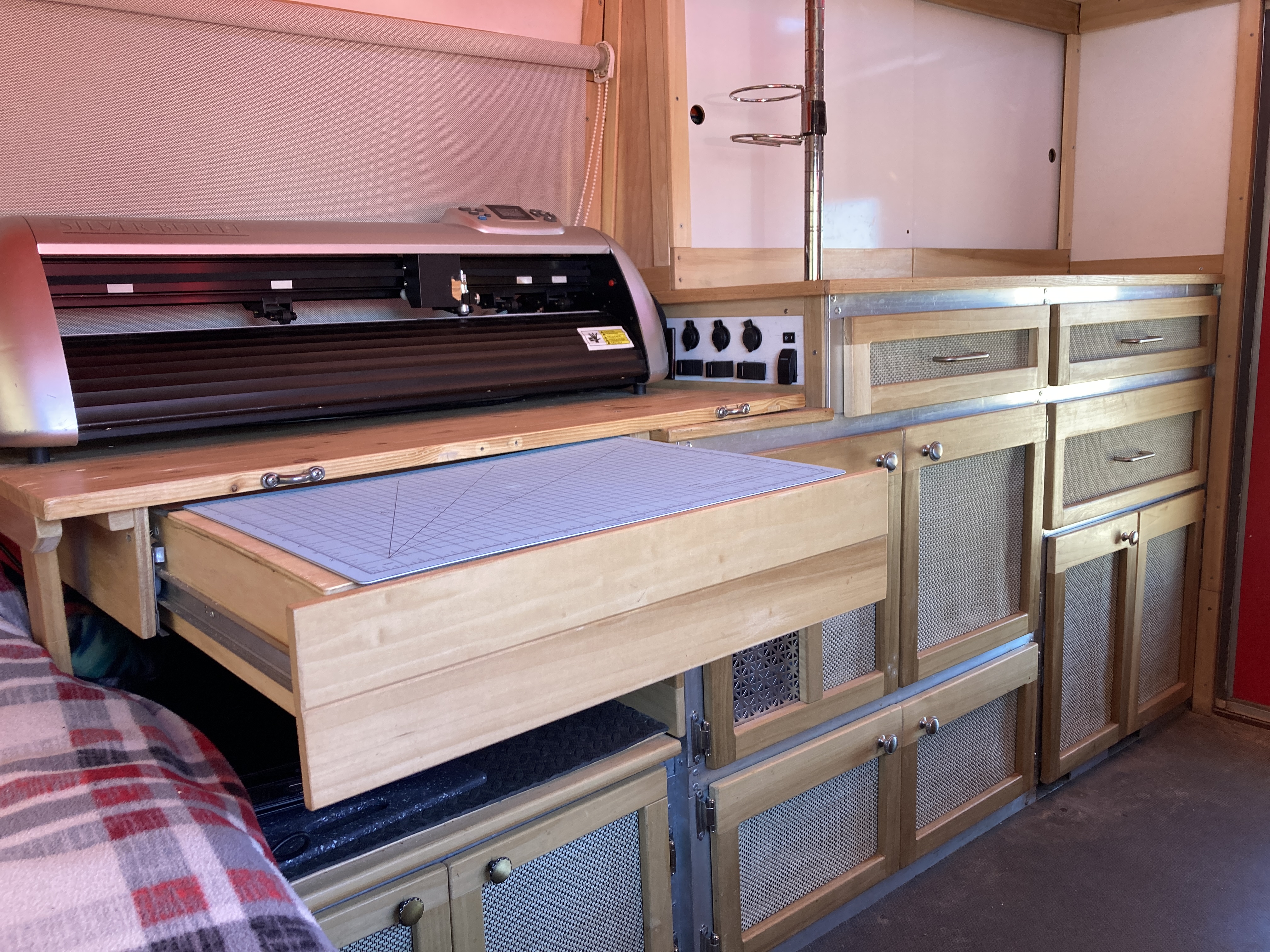
This week after looking for a while I finally found a vintage mini motor home, a 4 cylinder fiberglass. It crawls up hills at the speed of a turtle with butter on its paws! It might look big in the photo but it is only 18 feet long and fits in a normal sized parking space. But it is still tall enough to stand up in and wide enough to lie down in from side to side.
I wanted this rig because it is easy on the wallet for gas and being a vintage vehicle means it fits my miniature sized financial budget too. Very important to me is that it has a rear dinette area with big picture windows, bath, stove, fridge, sink etc.
This last week I camped in it at the NW School for Wooden Boat Building where I had volunteered to do some painting. We did not get much painting done but that was OK I still had a great time. I took a couple of photos at my camp site while looking out those picture windows. On one side the picture window was looking out at the water, sailboats and tug boats. The back window was looking out at a charming 1900's building that is home to a fun restaurant, the other side had a view of a row of tiny, colorful beach cottages. The front windows looked out at the boat school and more area of the bay. I forgot to take a snapshot of the cottages, I will do that in September when I go back for another visit. Very peaceful spot that is not in the main part of town, it is down a hill at the beach on a dead end road. Sorry but this is not an open to the public camping spot, it is on private property.
So now you understand all my current interest in things like hand saw systems and hand carving and light weight portable saw horses that I can take traveling with me. But in my little RV I will also create fitted storage areas for the small power tools like mini table saws, my drum sander, Dremel motors and such for when I have access to 110 volt power. If I wanted to build dollhouses in there I would have to stick to room boxes or the smaller scales. I plan on making 1:12 scale furniture in there and doing design work on my laptop.
This summer I will tackle the projects of replacing seal strips and caulking on all the openings to keep the rain out of it. After that I can think about the redecorating stuff and putting in a pine workbench top where the dining table used to be. How lovely to have a workbench with 3 big picture windows surrounding it and the possibility of changing the scenery when it takes my fancy to do so. Some days it will be water, another day it could be a forest or mountain peaks. Even a short trip to the big beach park just up the road yields yet another vision of lovely things to look at, sailboats racing by and big ships heading out to or coming in from Asia.
July 14, 2012
Hand Sawing System
photo from http://www.fine-tools.com/miter-sawguide.htmlhttp://www.fine-tools.com/miter-sawguide.html
It is of course possible to build a fantastic dollhouse using no power tools at all. They did that for a great many centuries. Precision hand sawing does take some practice and it helps to have some good advice on how to do it. I learned a lot from watching this episode of "The Woodwright's Shop". But if you don't think you are up to that then don't worry because there is a terrific little miter saw system for Japanese hand saws that will make accurate cross cuts and rip cuts with virtually no practice at all. It is unlikely you will find it in most local hardware stores but it is available over the internet in many different countries.
With this saw you can make accurate, angled, rip cuts by hand. That means you can also make compound angle cuts with this system when using a fence. Trust me, that is a BIG deal in dollhouse building when you want to put dormer roofs on a main roof or when you want to put a roof on a tower or gazebo. It is an even bigger deal to be able to do it accurately with a hand saw. Not saying it is effortless as you must be very careful with your measurements, setting up the fence and with aligning the saw with the cutting mark but that is true for the of making all cuts made with power tools or by hand.
This would be great for apartment dwellers who have limited storage space but still love to make things. I purchased one to put in my future mobile workshop in places where I want to work very quietly or where I have no electricity to plug into. With it I could make all the cuts needed for a dollhouse shell other than window and door openings. But those are also easy to do with hand tools all you need is a keyhole saw and a drill, or a panel saw that has a curved blade to let you start a cut in the middle of a board.
Note that the larger miter saw system may or may not include a saw with it so be sure to check before you order. If the seller has not included a saw in the package you buy will need to purchase the saw separately. You will need a Japanese Kataba saw, one that has no back spine on it.
So if being afraid of using power tools has stopped you from building your dream house you no longer have an excuse. Just think what all the hand sawing action will do for your arms and pecs!
USA internet source for this saw system
http://www.traditionalwoodworker.com/Mini-Precision-Saw-Guide-Kit/productinfo/406-8085/
It is of course possible to build a fantastic dollhouse using no power tools at all. They did that for a great many centuries. Precision hand sawing does take some practice and it helps to have some good advice on how to do it. I learned a lot from watching this episode of "The Woodwright's Shop". But if you don't think you are up to that then don't worry because there is a terrific little miter saw system for Japanese hand saws that will make accurate cross cuts and rip cuts with virtually no practice at all. It is unlikely you will find it in most local hardware stores but it is available over the internet in many different countries.
With this saw you can make accurate, angled, rip cuts by hand. That means you can also make compound angle cuts with this system when using a fence. Trust me, that is a BIG deal in dollhouse building when you want to put dormer roofs on a main roof or when you want to put a roof on a tower or gazebo. It is an even bigger deal to be able to do it accurately with a hand saw. Not saying it is effortless as you must be very careful with your measurements, setting up the fence and with aligning the saw with the cutting mark but that is true for the of making all cuts made with power tools or by hand.
This would be great for apartment dwellers who have limited storage space but still love to make things. I purchased one to put in my future mobile workshop in places where I want to work very quietly or where I have no electricity to plug into. With it I could make all the cuts needed for a dollhouse shell other than window and door openings. But those are also easy to do with hand tools all you need is a keyhole saw and a drill, or a panel saw that has a curved blade to let you start a cut in the middle of a board.
Note that the larger miter saw system may or may not include a saw with it so be sure to check before you order. If the seller has not included a saw in the package you buy will need to purchase the saw separately. You will need a Japanese Kataba saw, one that has no back spine on it.
So if being afraid of using power tools has stopped you from building your dream house you no longer have an excuse. Just think what all the hand sawing action will do for your arms and pecs!
USA internet source for this saw system
http://www.traditionalwoodworker.com/Mini-Precision-Saw-Guide-Kit/productinfo/406-8085/
July 13, 2012
Dollhouse Dormer Part 3
Today I am cutting the window openings in the dormers using a miniature table saw with a 3 and3/8" diameter blade.
First thing to do is draw lines right onto your tablesaw top. Use a felt tip marker and a straight edge draw a put a line across the top that is the same width of the saw blade that runs parallel with the blade. Then draw a line perpendicular to that line to indicates the center of the saw blade's arbor hole.
That intersection of those two lines is the center point of where your blade will come through when you raise it up through your panel.
The first two sides of the window openings, top and bottom, were done using the table saw fence against the bottom edge of the dormer. The top point of the dormer lines up with the line indicating center of the arbor.
The last two cuts are created by placing the bottom edge of the dormer against the miter fence and using those lines on the table top as my reference point I line up the dormer to center the blade on my cutting line.
Because my window is centered on the peak of the dormer I have used double back tape to stick to temporary plywood fences to the top of my table saw (those are the light colored wood). Now I can just flip the dormer piece over after making the first cut to make the second cut without recalibrating my position. Note in the photo that I have clamped the dormer to the table saw top to make these cuts. When it is possible to use clamps I always take the time to do so instead of risking my fingers.
July 4, 2012
Got Birds?
On holidays and weekends my two cats get to go out into the hallway. They love to run up and down the stairs playing tag. Sitting in the birdhouse that now serves as a hideout, ready to launch a sneak attack, is one of the games they play.
A few years ago they actually did catch a big fat mouse in this hallway at the bottom of the stairs. I am sure they would be thrilled if another mouse came into the building.
June 20, 2012
power strop to go
More work done today on my new carving stand including a way to power hone my tools for those scary sharp edges that cut wood as if it were butter.
My carving stand was built using a "hide-a-horse", lightweight (7lbs) folding saw horse. I love it, it sets up in seconds but folds up into a very small package easy to store under a bed or in a closet.
Watch the video on this link to see how it works http://hideahorsefoldingsawhorses.com/
I put a layer of thin adhesive backed cork sheeting over the magnetic, stainless steel knife bar. I purchased the bar from my local Ikea store but they can also be found on Amazon or Ebay. The length of the bar is what determined the size of my carving stand. I like the stand to be that long because it keeps the C clamps that attach the stand to the sawhorse, desk or table top from hitting my knees. Also it gives me lots of room for hanging up carving tools. The cork sheeting is shelf liner from the Contact brand. You can find it in hardware, home center stores and places such as Walmart.
Another chore today was mounting a honing disk onto a mandrel so I could use it in my battery powered drill motor. This kind of mandrel can be found in hardware stores. The honing wheel is made by gluing layers of mat board together. Be sure to carefully cut the circles so you don't have to do a lot of sanding to true up the disk surface after the glue is dry. Use the motor turning against a sanding block. But to get that chore done even faster turn it with the drill motor against a running power sander.
The green color on the wheel is honing compound. The wheel does not need to be charged with compound very often, it last a good long while.
Another new discovery today is an easy way to mount my flat backed small carving projects, such as door panels, onto the tool post. Scotch 3M restickable tabs for mounting. They are a bit thick and somewhat soft. If you put a lot of pressure on your tools the work might shift a fraction because of that soft factor. But with normal work on flat miniature carvings you will be using really sharp miniature tools and there should not be much pressure on the wood . You can cut these tabs into smaller sections to them spread around the surface for better gripping on larger pieces. To release the piece from the tool post just twist it clockwise or counterclockwise, don't pry it off. I like that there is no tape residue left behind. If the restickable tabs lose their grip simply rinse with soapy water and they start working again. How cool is that? Like any new product be sure test it on a scrap piece before using on something valuable to you. If it does not work for your carvings don't worry because you will find many other uses for this product.
June 10, 2012
Where the Wild Things Live
The good thing about travel is all the interesting local characters you meet. This weekend I am doing a bit of international travel. Not all that far from home, it is only two hours of a drive from Seattle to the city of Vancouver British Columbia, Canada. It has been a few years since I took a leisurely trip here with no agenda other than having a fun and interesting time.
Can't you just hear this big guy saying "let the wild rumpus begin"?
Look closely at him, each of the horns on his head has a face carved into it.
These photos were taken at the Museum of Anthropology.
The scale of the items in the museum ranges from massive on down to tiny miniatures. The collections have a broad range. The majority of the museum collection is focused on North West, pacific coast native art. However there are hand made items of many types from all over the world. There is also a section of the museum devoted to early European Pottery.
Outside in the "back yard" are recreations of dwellings. Many swallows were busy swooping around the hill and over the pond.
The Austrian tiled stove from the museum's ceramics collection. There are also rooms full of beautiful baskets, Greek pottery and of course thousands of carvings in display cases and drawers.
I am staying at a hostel on the campus of the University of British Columbia in Vancouver. What a great location, just a few blocks from the Anthropology Museum. Right next to the hostel is a lovely Japanese Garden. For only $33.00 a night I have a nice private room in an incredible location. It is an easy scenic, waterfront hugging, 20 minute drive into downtown Vancouver. The whole of the campus is beautifully landscaped and it is surrounded by a huge regional park with hiking and biking trails. How often do you get a location to stay that is forest, waterfront and right in the middle of a major metropolitan city? This certainly does not feel like traveling on a small retirement budget! Today I am heading to the dollhouse miniature show that is being held in Vancouver this weekend.But first comes a short hike in the Universities Botanical Garden followed by breakfast at a waterfront park.
June 5, 2012
Cutting Dormers: part 2
This time I am using the same miter slot sled jig I made in part 1 to cut a dormer for the back of my structure and also the two side gable ends. These pieces are triangular without any vertical side lengths. I have changed the angle of my miter fence using the 60 degree drafting triangle and now the base of the triangle will rest against the fence unlike in part 1 where the vertical sides were resting against the fence.
The first step was to cut a piece of material to the width of the base of the triangle given in my measured drawing.
The right side of my jig was cut off by the saw blade so that is an easy indicator of where the actual cutting line is and I will make use of it as the registration for the point of my triangle. All I have to do is place a scrap piece of plywood at the corner where the fence and that right side of the jig intersect. Then I butt the material I am using for the dormer over to that location, remove the scrap and while holding the material down on the jig against the fence I slide it on through the saw blade to make the first cut. I always turn off the saw motor and let it come to a full stop before removing the part from the jig or trying to remove the waste cutoff piece.
Now flip your material over, register it again to that same intersection as in the last step (don't forget to remove that scrap you used to located the corner of the triangle) and then cut the last side of the triangle. The peak of your triangle will be perfectly centered across the width and that means it will also be the correct height. This is a very simple method once you get the hang of making triangles this way on your table saw. But if you are going to do lots of them exactly the same size for a production type of product then use a stop block on the left end of the fence instead of registering your pieces it to the corner each time.
I will do a post on making the roof cuts for the dormers later, it involves making compound cuts, a bit more complicated as you have to make a left and a right side but it is also done with a miter slot jig.
Link to Cutting Dormers: part 1
Labels:
dormers,
how to,
jigs,
roof,
wood working
Subscribe to:
Posts (Atom)